Why Trust AllQbanks? We help thousands of IMGs and Canadian medical students prepare for the MCCQE every year. Our study guides are verified against official MCC objectives and informed by proprietary performance data from our 5,200+ question testing platform. Read our Editorial Policy.
NBME self-assessments are the most accurate predictor of your Step 1 performance. Not your QBank percentage, not your UWorld average, not your gut feeling. NBME forms test the same question style, difficulty, and content distribution as the real exam because they're written by the same people.
This guide covers which forms to take, when to take them, how to interpret your scores, and how the Free 120 fits into your prep timeline.
Key Takeaways
- NBME Comprehensive Basic Science Self-Assessments (Forms 25–31) are the gold standard for predicting Step 1 readiness (NBME.org, 2026).
- Each NBME form costs $60 and provides a pass/fail prediction with a performance profile.
- The Free 120 is a free, 120-question practice test available on USMLE.org in the actual exam interface.
- Schedule NBMEs every 7–10 days during dedicated study. Don't book your exam until you're consistently scoring 70%+ correct.
What Are NBME Self-Assessments?
NBME Comprehensive Basic Science Self-Assessments (CBSSAs) are official practice exams created by the National Board of Medical Examiners — the same organization that writes USMLE Step 1. Each form contains approximately 200 questions covering the full Step 1 content outline.
Available Forms
| Form | Status | Notes |
|---|---|---|
| Forms 25–26 | Available | Older forms, slightly less representative of current content |
| Forms 27–29 | Available | Good mid-range forms |
| Forms 30–31 | Available | Newest forms, most representative of current exam |
| Free 120 | Free on USMLE.org | 120 questions in the actual exam interface |
Forms 25–31 cost $60 each through the MyNBME portal at nbme.org. The Free 120 is available at no cost on usmle.org.
How to Interpret Your NBME Score
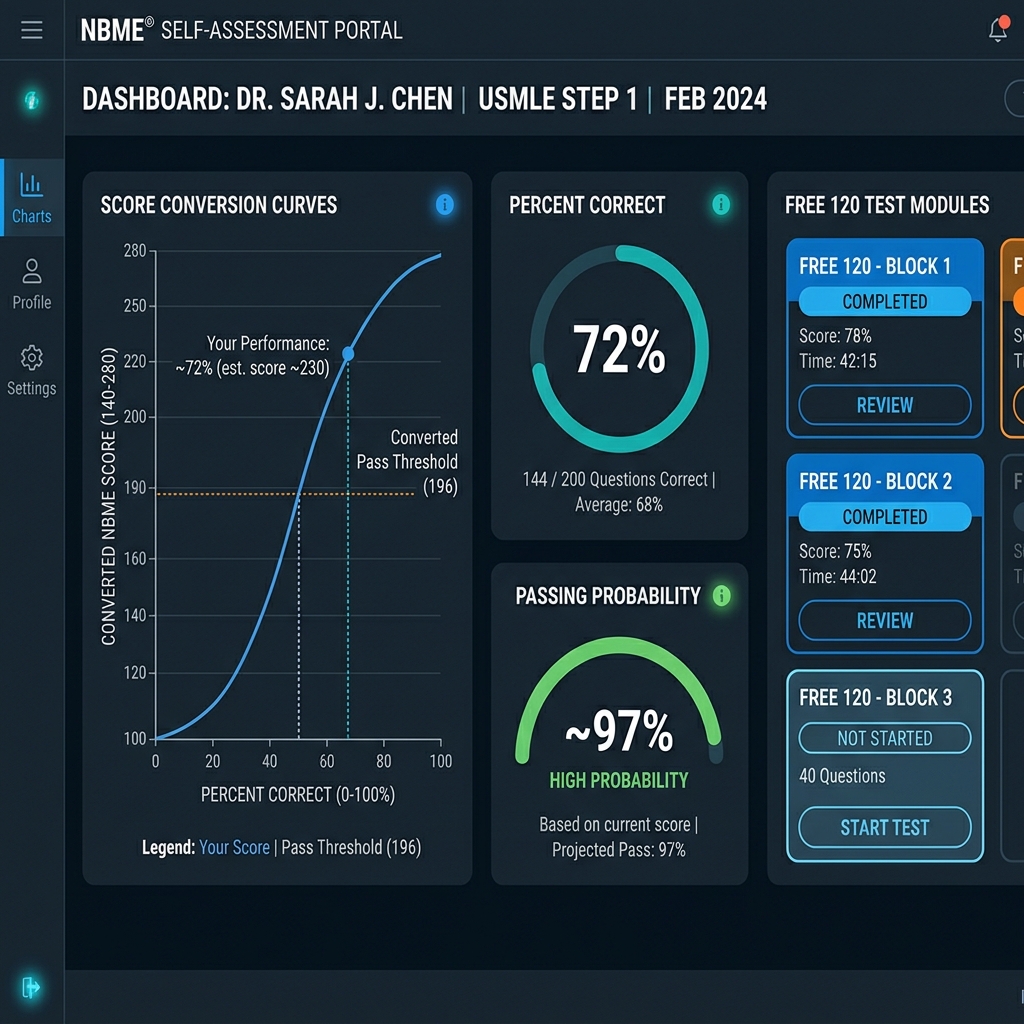
Since Step 1 moved to Pass/Fail, NBME self-assessments no longer report three-digit scores. Instead, you receive:
- Pass/Fail prediction — "Passing Performance" or "Borderline/Below Passing Performance."
- Performance profile — A breakdown showing your relative strength across content areas (Same as, Lower than, or Higher than the borderline passing group).
- Percentage correct — The raw percentage you can calculate from your number correct vs total questions.
What Percentage Correct Means
| % Correct | Interpretation | Action |
|---|---|---|
| < 55% | Well below passing threshold | Extend your study period by 2–4 weeks |
| 55–60% | Below passing — borderline risk | Needs significant improvement, do not schedule exam |
| 60–65% | At the passing threshold (~196) | Passing is possible but not safe — keep studying |
| 65–70% | Above passing — likely safe | Continue studying, aim higher if time allows |
| 70–75% | Comfortable pass | You're ready. Schedule your exam with confidence. |
| > 75% | Strong pass | Excellent. Finish your review and take the exam. |
Score Trends Matter More Than Single Scores
A single NBME score is a snapshot. What matters is the trend across 3–4 assessments:
- Upward trend: You're improving. Keep doing what you're doing.
- Flat trend at 65%+: You've plateaued but are passing. Consider scheduling.
- Flat trend below 65%: You've plateaued below the safety margin. Change your study strategy — more volume won't help.
- Downward trend: Something is wrong. You may be burning out. Take a day off and reassess.
When to Take Each NBME Form
Recommended Schedule During 6-Week Dedicated
| Week | NBME Form | Purpose |
|---|---|---|
| Pre-dedicated (baseline) | Form 25 or 26 | Establish starting point and identify weakest systems |
| Week 1 (Day 7) | Form 25 or 26 | Confirm baseline, calibrate schedule length |
| Week 3 (Day 21) | Form 27 or 28 | Mid-point check — verify upward trend |
| Week 4 (Day 28) | Form 29 | Confirm approaching safety threshold |
| Week 5 (Day 35) | Form 30 or 31 | Decision point — schedule exam if 70%+ |
| Week 6 (Day 38) | Free 120 | Final readiness check in actual exam interface |
Spacing Rules
- Minimum 7 days between forms. Your brain needs time to consolidate knowledge between assessments.
- Don't take more than 5 NBMEs total. There are only 7 forms available, and each one has unique questions. Don't waste them early.
- Save Form 30 or 31 for last. These are the newest and most representative.
The Free 120: Your Final Checkpoint
The Free 120 is different from NBME CBSSAs in several important ways:
| Feature | NBME CBSSAs (25–31) | Free 120 |
|---|---|---|
| Questions | ~200 | 120 |
| Interface | NBME self-assessment portal | Actual USMLE exam interface |
| Cost | $60 per form | Free |
| Score report | Pass/fail prediction + profile | Percentage correct only |
| Content | Full Step 1 blueprint | Full Step 1 blueprint |
| Best timing | During dedicated study | 3–5 days before exam |
Why the Free 120 Matters
The Free 120 uses the same software interface you'll see on exam day. Taking it isn't just about the score — it's about reducing test-day anxiety by familiarizing yourself with the layout, navigation buttons, highlighting tools, and timer display.
How to Interpret Your Free 120 Score
| Free 120 Score | Step 1 Prediction |
|---|---|
| < 60% | High risk of failing — consider postponing |
| 60–70% | Borderline — you're at risk |
| 70–80% | Likely pass — finish your review |
| 80%+ | Strong pass — you're ready |
Most students score slightly higher on the Free 120 than on NBME CBSSAs, so don't use an inflated Free 120 score as your sole confidence metric. Cross-reference with your NBME trends.
How to Use Your Performance Profile
Your NBME performance profile shows relative performance across these areas:
- Individual organ systems (Cardiovascular, Renal, GI, etc.)
- Basic science disciplines (Pathology, Physiology, Pharmacology, etc.)
- Physician tasks (Medical Knowledge, Diagnosis, Pharmacotherapy)
Focus on "Lower" rated areas. If your profile shows "Lower" in Renal or Pharmacology, those are your highest-return study areas for the next assessment. Spending 3 days drilling your weakest system will improve your overall score more than reviewing a system you're already strong in.
Common Mistakes with Practice Assessments
Taking too many forms too quickly. Some students burn through 4 NBME forms in 2 weeks. That's not enough time between assessments for meaningful score improvement. Space them out.
Reviewing NBME questions but not learning from them. After each form, go through every question you got wrong (and every question you guessed on correctly). Identify the underlying concept, not just the right answer. Add these to your review list or Anki deck.
Ignoring the performance profile. The profile is more actionable than the overall score. A student scoring 68% with "Lower" in 3 systems has a clear study plan. A student scoring 68% with "Same" across everything needs more volume.
Using the Free 120 too early. Save the Free 120 for 3–5 days before your exam. It's your final sanity check and interface practice, not a mid-study diagnostic.
Other Practice Assessment Options
UWorld Self-Assessments
UWorld offers simulated exams that provide a predicted three-digit score and detailed analytics. At $50–$75 each, they're useful as supplementary assessments but are slightly less predictive than official NBME forms.
Kaplan Free Diagnostic
A free 3-hour diagnostic exam from Kaplan that provides performance feedback by subject. It's worth taking early in your prep for a free baseline — even if you don't use Kaplan for your primary study.
How to Run a Full-Day Simulation
Official NBMEs are only ~200 questions — shorter than the real exam's 280. To simulate the full 14-block experience, build your own simulation using your QBank:
Simulation Setup
| Component | Settings |
|---|---|
| Questions per block | 20 |
| Time per block | 30 minutes |
| Total blocks | 14 |
| Total questions | 280 |
| Mode | Timed, random, all subjects |
| Break rules | 55 minutes total, self-paced |
Simulation Day Schedule
| Time | Activity |
|---|---|
| 8:00 AM | Start Block 1 |
| 8:30 AM | Block 2 |
| 9:00 AM | Block 3 |
| 9:30 AM | Block 4 |
| 10:00 AM | Break 1 (8 min) |
| 10:08 AM | Block 5 |
| 10:38 AM | Block 6 |
| 11:08 AM | Block 7 |
| 11:38 AM | Lunch break (15 min) |
| 11:53 AM | Block 8 |
| 12:23 PM | Block 9 |
| 12:53 PM | Block 10 |
| 1:23 PM | Break 2 (8 min) |
| 1:31 PM | Block 11 |
| 2:01 PM | Block 12 |
| 2:31 PM | Break 3 (8 min) |
| 2:39 PM | Block 13 |
| 3:09 PM | Block 14 |
| 3:39 PM | Done |
Simulation Rules
- No phone access during the simulation.
- Only eat during designated breaks.
- Wear what you'll wear on test day.
- Sit at a desk, not on your bed or couch.
Do at least one full-day simulation during dedicated study, ideally around Week 4. It builds the stamina and break management instincts that individual QBank blocks can't replicate.
For a complete study schedule incorporating these assessments, see our USMLE Step 1 Study Plan. To understand the overall exam format and what you're preparing for, read our Complete USMLE Step 1 Guide.
Frequently Asked Questions
How much do NBME self-assessments cost?
Each NBME CBSSA form costs $60 through the MyNBME portal. The Free 120 on USMLE.org is free. Budget $180–$300 for 3–5 NBME forms during your dedicated study period.
How many NBME forms should I take?
Most students take 3–5 forms during dedicated study. More than 5 is unnecessary — you'll run out of unique forms and the additional assessments cut into your actual study time.
Are older NBME forms still useful?
Forms 25–26 are still valid for establishing a baseline, but they're less representative of current exam content than Forms 30–31. Use older forms early in your dedicated period and save the newest forms for later.
What if my NBME score drops?
A single drop doesn't mean you're regressing. Score fluctuation of 3–5 percentage points between forms is normal due to content variability. Look at the trend across 3+ forms, not individual data points. If you see a consistent downward trend, assess for burnout and consider adjusting your study approach.
Can I retake an NBME form?
You can repurchase and retake the same form, but the questions are identical. Your score will be inflated by recall, so retaking provides limited diagnostic value. Use a different form instead.
What's the correlation between Free 120 and Step 1?
Students typically score slightly higher on the Free 120 than on actual NBME CBSSAs. A Free 120 score of 75%+ generally correlates with a comfortable Step 1 pass. Below 65% suggests meaningful risk.
Related Posts
![NAC OSCE 2026: Complete Preparation Guide [Format, Stations, Pass Score]: feature image](/img/nac-osce-guide.webp) mccqe
mccqeNAC OSCE 2026: Complete Preparation Guide [Format, Stations, Pass Score]
Everything you need for the NAC OSCE in 2026: exam format, all 12 station types, the ~577 pass score, and the 5 mistakes that fail most IMGs. Includes a.
Dr. Leila Haddad •
Feb 18, 2026
 nclex
nclexNCLEX Bootcamp Review: Is It the Best Prep Course in 2026?
NCLEX Bootcamp review for 2026: question quality, 50 NGN video case studies, 4 readiness exams, cheat sheets, pricing, and who it works best for.
AllQbanks Team •
Sep 4, 2026