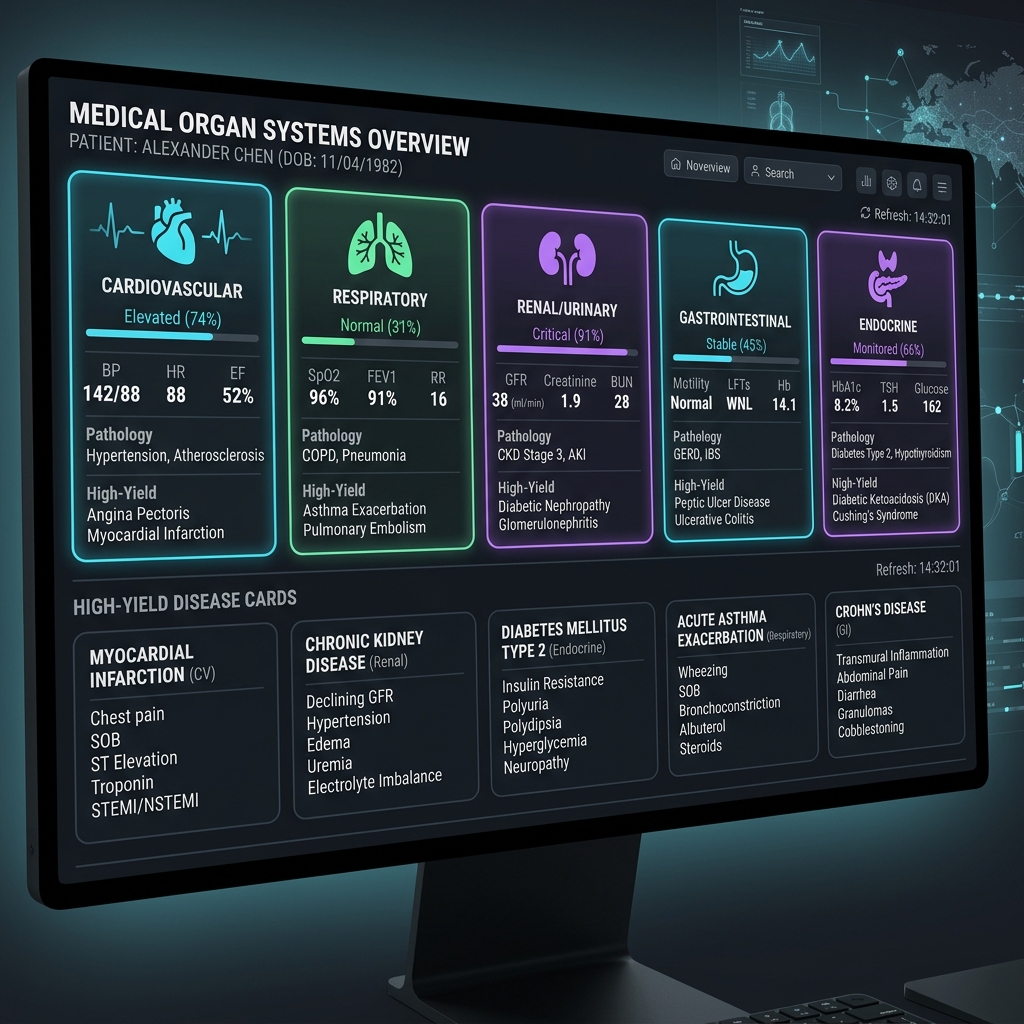
Why Trust AllQbanks? We help thousands of IMGs and Canadian medical students prepare for the MCCQE every year. Our study guides are verified against official MCC objectives and informed by proprietary performance data from our 5,200+ question testing platform. Read our Editorial Policy.
Not every topic on Step 1 gets equal weight. The NBME publishes official content specifications that tell you exactly how many questions come from each organ system and each physician task category. If you study without this information, you're guessing about what matters.
This guide breaks down the official 2026 content weightings, then lists the must-know diseases, pharmacology concepts, and biochemistry pathways that appear repeatedly on NBME forms.
Key Takeaways
- Pathology is the single highest-weighted basic science (45–52% of items involve pathological processes). Physiology is second (25–35%), Pharmacology third (15–22%) (USMLE Content Outline, 2026).
- General Principles of Foundational Science accounts for 15–20% of total exam items — this is your highest-leverage study category.
- Behavioral Health & Nervous System is the largest single organ system block at 10–14%.
- Questions almost never test pure recall. They present a clinical scenario and ask you to apply basic science principles.
Official Organ System Weightings (Table 1)
Source: USMLE Step 1 Content Outline, 2026.
| System | Weight (%) | What They Test |
|---|---|---|
| General Principles | 15–20% | Cell biology, neoplasia, inflammation, general pharmacokinetics, tissue repair |
| Behavioral Health & Nervous System | 10–14% | Stroke syndromes, neurodegenerative disease, psychopharmacology, sleep, cranial nerves |
| Blood, Lymphoid & Immune | 9–13% | Anemias, leukemias, immunodeficiencies, hypersensitivity (Types I–IV) |
| Multisystem Processes | 8–12% | Acid-base, nutrition, sepsis, temperature regulation, vasculitis |
| Cardiovascular | 7–11% | Ischemic heart disease, valvular disease, congenital defects, antihypertensives |
| Endocrine | 7–11% | Thyroid disorders, diabetes, adrenal pathology, MEN syndromes |
| GI | 7–11% | Hepatitis, IBD, liver cirrhosis, GI hormones, peptic ulcer disease |
| Renal & Urinary | 7–11% | Glomerulonephropathies, tubular defects, acid-base compensation, AKI/CKD |
| Respiratory | 7–11% | Obstructive vs restrictive, PE, ARDS, ABG interpretation |
| Musculoskeletal & Skin | 6–10% | Autoimmune CTD (SLE, RA), bone pathology, dermatologic lesions |
| Reproductive | 6–10% | Ovarian/testicular pathology, cervical neoplasia, preeclampsia, STIs |
Physician Task Weightings (Table 2)
| Task Category | Weight (%) |
|---|---|
| Medical Knowledge & Basic Science Application | 60–70% |
| Patient Care: Diagnosis | 20–25% |
| Pharmacotherapy & Interventions | 5–10% |
| Communication & Medical Ethics | 3–6% |
The implication: roughly two-thirds of Step 1 tests your ability to connect a clinical presentation to a basic science mechanism. The remaining third asks for diagnosis, treatment, or ethical reasoning.
High Yield Diseases by System
General Principles & Cell Pathology
These concepts appear across multiple organ systems:
Necrosis types: Coagulative (heart/kidney), liquefactive (brain/abscess), caseous (TB), fat (pancreatitis), fibrinoid (malignant HTN/vasculitis). Know the histological appearance and the organ association.
Inflammation: Neutrophil chemotaxis factors (C5a, LTB4, IL-8). Granulomatous inflammation — epithelioid macrophages and Langerhans giant cells. Diseases: TB, sarcoidosis, Crohn's, berylliosis, cat scratch disease.
Neoplasia: Tumor suppressors (Rb, p53, APC, BRCA) vs oncogenes (Ras, Myc, HER2). Li-Fraumeni syndrome (p53 mutation). Tumor markers (PSA, AFP, CA-125, CEA).
Nervous System & Behavioral Health
Stroke syndromes: ACA — contralateral lower extremity weakness. MCA — contralateral upper extremity/face weakness + aphasia (dominant hemisphere). PCA — contralateral homonymous hemianopia.
Neurodegenerative disorders: Alzheimer's (neurofibrillary tangles, beta-amyloid plaques). Parkinson's (Lewy bodies — alpha-synuclein, substantia nigra). ALS (upper + lower motor neuron signs). Huntington's (caudate atrophy, autosomal dominant, CAG repeats).
Psychiatry: Know the DSM-5 criteria for major depressive disorder, schizophrenia, bipolar disorder, and anxiety disorders. Psychopharmacology mechanisms: SSRIs, SNRIs, MAOIs, typical vs atypical antipsychotics (D2 blockade vs serotonin-dopamine antagonism).
Cardiovascular & Renal
MI timeline: 0–24 hrs (wavy fibers, coagulative necrosis), 1–3 days (neutrophils), 3–14 days (macrophages + granulation tissue), 2+ weeks (scar formation). This is tested constantly.
Glomerulonephropathies: Nephritic syndrome (PSGN, IgA nephropathy, Goodpasture) vs Nephrotic syndrome (Minimal change, Membranous, FSGS, Diabetic). Know the light microscopy, IF, and EM findings.
Antihypertensives in pregnancy: Hydralazine, Methyldopa, Labetalol, Nifedipine. Mnemonic: "He Likes My Neonate."
GI & Endocrine
Hepatitis serology: Know the interpretation of HBsAg, anti-HBs, anti-HBc IgM/IgG, HBeAg. Distinguish acute infection, chronic infection, immunized, and window period.
Diabetes types: Type 1 (autoimmune beta-cell destruction, anti-GAD antibodies) vs Type 2 (insulin resistance). DKA (Type 1, high anion gap metabolic acidosis) vs HHS (Type 2, severe hyperosmolarity).
Thyroid disorders: Graves (TSI, diffuse uptake) vs Hashimoto's (anti-TPO, anti-thyroglobulin). Thyroid storm management. Subacute thyroiditis (de Quervain — painful, post-viral).
High Yield Pharmacology
CYP450 Enzymes
Inducers (decrease drug efficacy): Phenytoin, Carbamazepine, Rifampin, St. John's Wort, Chronic alcohol, Griseofulvin, Modafinil, Barbiturates.
Inhibitors (increase drug toxicity): Macrolides (Erythromycin), Azole antifungals, Cimetidine, Grapefruit juice, Protease inhibitors, Amiodarone, Isoniazid.
Antiarrhythmics (Vaughan-Williams Classification)
| Class | Mechanism | Examples | Clinical Use |
|---|---|---|---|
| Ia | Na+ channel blocker (intermediate) | Quinidine, Procainamide | Atrial/ventricular arrhythmias |
| Ib | Na+ channel blocker (fast) | Lidocaine, Mexiletine | Ventricular tachycardia post-MI |
| Ic | Na+ channel blocker (slow) | Flecainide, Propafenone | SVT (avoid post-MI) |
| II | Beta-blocker | Metoprolol, Atenolol | Rate control, post-MI |
| III | K+ channel blocker | Amiodarone, Sotalol | Refractory arrhythmias |
| IV | Ca2+ channel blocker | Verapamil, Diltiazem | SVT, rate control |
Autonomic Nervous System Receptors
| Receptor | Location | Effect | Pathway |
|---|---|---|---|
| Alpha-1 | Vascular smooth muscle | Vasoconstriction | IP3/DAG (Gq) |
| Alpha-2 | Presynaptic neurons | Decreased sympathetic outflow | Gi (↓cAMP) |
| Beta-1 | Heart, kidney | ↑HR, ↑contractility, renin release | Gs (↑cAMP) |
| Beta-2 | Bronchi, vessels | Bronchodilation, vasodilation | Gs (↑cAMP) |
| M1 | CNS, stomach | ↑cognition, ↑acid secretion | Gq |
| M2 | Heart | ↓HR, ↓conduction | Gi |
| M3 | Smooth muscle, glands | Contraction, secretion | Gq |
High Yield Biochemistry
Rate-Limiting Enzymes
| Pathway | Rate-Limiting Enzyme |
|---|---|
| Glycolysis | Phosphofructokinase-1 (PFK-1) |
| Gluconeogenesis | Fructose-1,6-bisphosphatase |
| TCA Cycle | Isocitrate dehydrogenase |
| Glycogenesis | Glycogen synthase |
| Glycogenolysis | Glycogen phosphorylase |
| De novo purine synthesis | PRPP amidotransferase |
| Fatty acid synthesis | Acetyl-CoA carboxylase |
| Cholesterol synthesis | HMG-CoA reductase |
| Urea cycle | Carbamoyl phosphate synthetase I |
Glycogen Storage Diseases
| Type | Name | Enzyme Deficiency | Key Findings |
|---|---|---|---|
| I | Von Gierke | Glucose-6-phosphatase | Severe hypoglycemia, hepatomegaly, ↑lactate, ↑uric acid |
| II | Pompe | Lysosomal acid maltase | Cardiomegaly, hypotonia ("Pompe = Pump") |
| III | Cori | Debranching enzyme | Mild hypoglycemia, normal lactate |
| V | McArdle | Muscle glycogen phosphorylase | Exercise cramps, myoglobinuria |
Vitamin Deficiency Syndromes
| Vitamin | Deficiency | Key Features |
|---|---|---|
| B1 (Thiamine) | Wernicke-Korsakoff, Beriberi | Confusion, ataxia, ophthalmoplegia; wet = heart failure |
| B3 (Niacin) | Pellagra | Diarrhea, Dementia, Dermatitis (the 3 D's) |
| B6 (Pyridoxine) | Peripheral neuropathy | Isoniazid-induced; supplement during TB treatment |
| B12 (Cobalamin) | Subacute combined degeneration | Megaloblastic anemia, ↑MMA, ↑homocysteine |
| Folate | Neural tube defects | Megaloblastic anemia, normal MMA, ↑homocysteine |
| C (Ascorbic acid) | Scurvy | Swollen gums, petechiae, poor wound healing |
Note: Biochemistry questions on Step 1 almost never ask for pure enzyme structure. They present a patient with physical findings (e.g., infant with hypoglycemia and hepatomegaly) and ask which enzyme is deficient or which metabolite accumulates upstream.
How to Study High Yield Topics Efficiently
Don't try to memorize everything in First Aid. Focus on the topics above first. These represent the concepts that appear most frequently across NBME forms and the actual exam.
Use QBank data to identify your personal high-yield gaps. After completing 500+ UWorld questions, your performance analytics will show exactly which systems and subjects need the most attention. That data is more valuable than any generic "high yield" list.
Cross-reference with your NBME performance profile. If your NBME form shows "Lower" performance in Renal, spend extra time on glomerulonephropathies and acid-base — not on topics you're already strong in.
For practice questions covering these high-yield topics, see our USMLE Step 1 Practice Questions. For a complete study schedule that integrates these concepts, read our USMLE Step 1 Study Plan.
Frequently Asked Questions
What are the most tested subjects on Step 1?
Pathology is the highest-weighted basic science discipline (45–52% of items). Physiology is second (25–35%), and Pharmacology is third (15–22%). These three subjects together account for the vast majority of questions.
How many topics should I study for Step 1?
Focus on the official USMLE Content Outline categories. There are 11 organ system areas and 4 physician task categories. Within each, prioritize the high-yield diseases and concepts listed above rather than trying to cover everything in equal depth.
Is biochemistry high yield for Step 1?
Yes. Rate-limiting enzymes, glycogen storage diseases, and vitamin deficiency syndromes appear on virtually every NBME form. Biochemistry questions are typically 5–8% of the exam and are highly "learnable" because they follow predictable patterns.
What's the best resource for high yield pharmacology?
Sketchy Pharmacology for visual learners, combined with UWorld pharmacology questions for application practice. First Aid's pharmacology chapter provides a solid reference, but don't rely on reading it alone — you need to practice applying the concepts in clinical vignettes.
Should I study Step 1 content by system or by subject?
Study by system. That's how the exam is structured. Within each system, integrate all relevant basic sciences (anatomy, physiology, pathology, pharmacology) rather than studying pathology as an isolated subject.
Related Posts
![USMLE Step 1 Guide: Everything You Need to Know [2026]: feature image](/img/usmle-step-1-guide.png) usmle
usmleUSMLE Step 1 Guide: Everything You Need to Know [2026]
2026 USMLE Step 1 guide — new 14-block format, pass/fail scoring, eligibility, study resources, and how to build your prep strategy.
Dr. Leila Haddad •
Jul 28, 2026
 usmle
usmleUSMLE Step 1 Pass Rate 2026: Stats by MD, DO, IMG
2026 USMLE Step 1 pass rate by US MD, DO, and IMG candidates. Includes historical trends, retake rates, and what the numbers mean for prep.
Dr. Leila Haddad •
Jul 28, 2026