Why Trust AllQbanks? We help thousands of IMGs and Canadian medical students prepare for the MCCQE every year. Our study guides are verified against official MCC objectives and informed by proprietary performance data from our 5,200+ question testing platform. Read our Editorial Policy.
Your Step 1 study plan needs two things: a structure you can stick to and checkpoints that tell you whether it's working. Most students who fail Step 1 don't fail because they used the wrong QBank. They fail because they studied without a plan, skipped practice exams, or ignored their weak areas.
This guide gives you a complete framework — from building pre-dedicated habits during M1/M2 through a week-by-week dedicated schedule calibrated to the 2026 exam format.
Key Takeaways
- Start with a baseline NBME before building your schedule — your score determines your timeline (4-week, 6-week, or 8-week dedicated).
- Train with 20-question, 30-minute blocks to match the new 14-block exam format that launched May 14, 2026 (USMLE.org, 2026).
- Aim for 80–120 QBank questions per day during dedicated, with equal time spent reviewing explanations.
- Take an NBME every 7–10 days and don't schedule your exam until you're consistently above 70% correct.
Step 1: Determine Your Baseline
Before you build any schedule, take an NBME Comprehensive Basic Science Self-Assessment (Forms 25–31). Your baseline score tells you how much time you need:
| Baseline NBME Score | Recommended Dedicated Length | Starting Focus |
|---|---|---|
| < 50% correct | 8+ weeks | Heavy content review + QBank |
| 50–60% correct | 6 weeks | Balanced content + QBank |
| 60–70% correct | 4 weeks | QBank-heavy + targeted gaps |
| > 70% correct | 3–4 weeks | QBank + assessment-focused |
Don't skip this step. Students who start dedicated study without a baseline frequently misjudge their readiness and either waste time on material they already know or discover critical gaps too late.
For interpreting your baseline score and understanding NBME form accuracy, see our NBME Self-Assessment & Free 120 Guide.
Step 2: Pick Your Core Resources
Don't use everything. Pick one resource per category and commit:
| Category | Recommended | Alternatives |
|---|---|---|
| QBank | UWorld Step 1 | Amboss, Kaplan |
| Content review | First Aid + Pathoma | Boards & Beyond |
| Pharm & Micro | Sketchy Medical | Picmonic |
| Spaced repetition | AnKing Anki Deck | Custom cards |
| Practice exams | NBME Forms 25–31 + Free 120 | UWorld Self-Assessments |
UWorld is the single most important resource. If you can only afford one thing, get UWorld. Its explanations are detailed enough to replace textbook reading for most topics.
For detailed reviews of each platform, see our Best USMLE Step 1 QBanks & Prep Courses comparison.
Pre-Dedicated Phase (During M1/M2)
You don't need a rigid schedule during preclinical years. You need two habits:
Habit 1: Daily Anki. Start the AnKing Step 1 deck or your school's shared deck during M1. Even 30 minutes per day compounds massively over 18 months. The students who arrive at dedicated with 15,000+ mature cards have a massive advantage.
Habit 2: Organ-system QBank blocks. During each organ system block in M2, do 20–40 UWorld questions per day in that system. This builds NBME-style reasoning from the start rather than trying to learn it during dedicated.
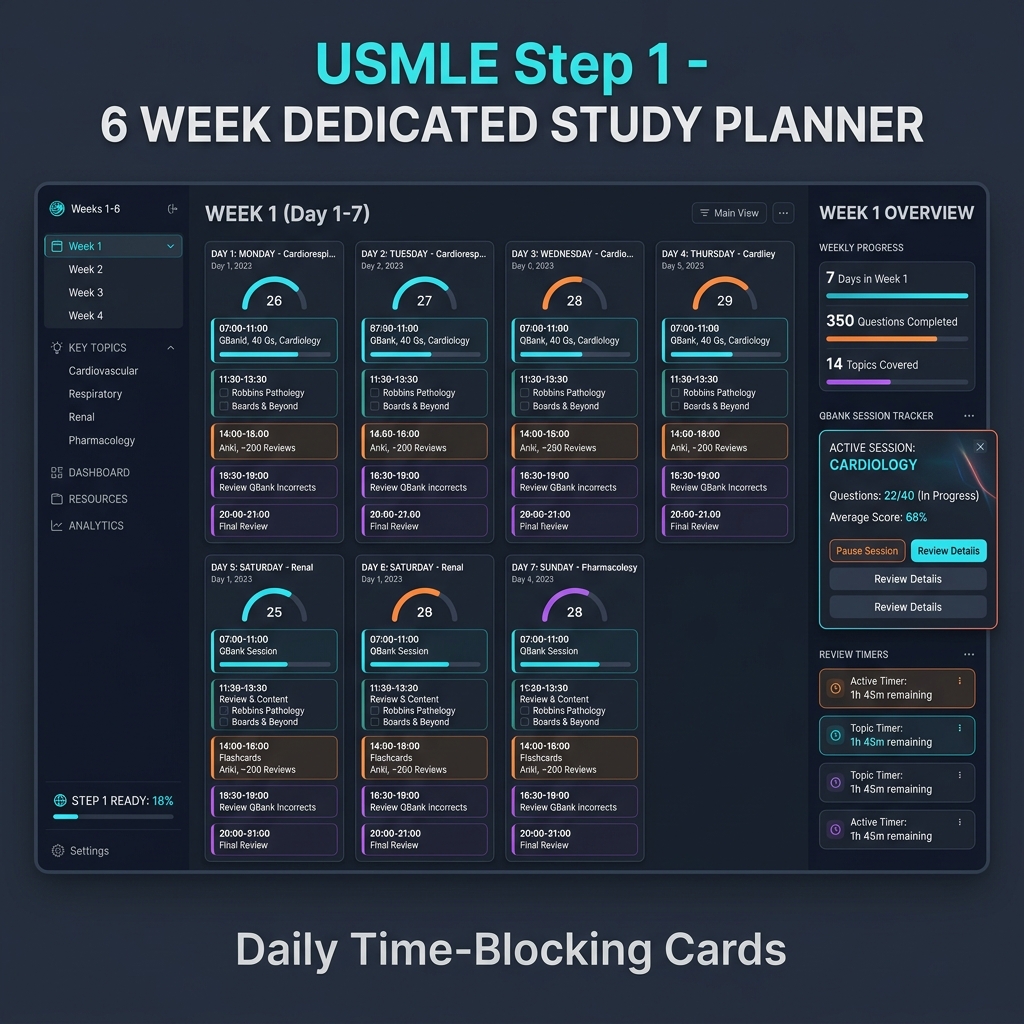
The 6-Week Dedicated Schedule (Week by Week)
This is the most common dedicated length. Adjust by adding or removing weeks based on your baseline.
Week 1: Foundation & Diagnostics
Goal: Establish your daily rhythm and identify your 3 weakest systems.
| Time | Activity | Details |
|---|---|---|
| 8:00–9:30 AM | QBank Block 1 | 20 questions, timed, random |
| 9:30–11:30 AM | Block 1 Review | Read every explanation, correct and incorrect |
| 11:30–12:30 PM | Break | Walk, eat, decompress |
| 12:30–2:00 PM | QBank Block 2 | 20 questions, timed, random |
| 2:00–4:00 PM | Block 2 Review | Annotate First Aid with new concepts |
| 4:00–5:30 PM | Targeted content review | Pathoma or Boards & Beyond for weakest system |
| 5:30–6:30 PM | Anki reviews | Clear your daily queue |
Week 1 milestone: Take NBME Form 25 on Day 7. Compare to your pre-dedicated baseline.
Week 2: System-Focused Remediation
Goal: Attack your 3 weakest systems with targeted QBank filters.
Keep the same daily structure but switch your afternoon content review to the systems where your NBME form showed "Lower than borderline" performance. Continue doing random QBank blocks in the morning to maintain exposure across all systems.
Week 2 milestone: Your daily QBank accuracy should be trending upward compared to Week 1.
Week 3: Volume Ramp
Goal: Increase to 100–120 questions per day (5–6 blocks of 20).
| Time | Activity |
|---|---|
| 8:00–9:30 AM | QBank Block 1 (20 Qs, timed) |
| 9:30–10:30 AM | Block 1 Review |
| 10:30–12:00 PM | QBank Block 2 (20 Qs, timed) |
| 12:00–1:00 PM | Break |
| 1:00–2:30 PM | QBank Block 3 (20 Qs, timed) |
| 2:30–3:30 PM | Block 3 Review |
| 3:30–5:00 PM | QBank Block 4 (20 Qs, timed) |
| 5:00–6:00 PM | Blocks 2–4 Review + Anki |
Week 3 milestone: Take NBME Form 27 on Day 21. You should see at least a 5-point improvement from your Week 1 form.
Week 4: Consolidation
Goal: Focus on high-yield cross-system topics and maintain QBank volume.
Prioritize these high-yield integrators:
- Biochemistry metabolic pathways (rate-limiting enzymes, glycogen storage diseases)
- Pharmacology mechanisms & CYP450 interactions
- Biostatistics and epidemiology (sensitivity, specificity, PPV/NPV, study design)
- Behavioral science and medical ethics
These topics appear across multiple organ systems and are highly "learnable" in a short time.
Week 4 milestone: Take NBME Form 28 or 29. Target: 65%+ correct with 85%+ passing probability.
Week 5: Simulation & Speed
Goal: Full exam simulations under test-day conditions.
Do at least one full-day simulation: 14 blocks of 20 questions back-to-back with only your allotted break time. This builds stamina for the new exam format.
Continue your morning QBank blocks but shift afternoon time to reviewing your personal "wrong answers" log. Every student has patterns — maybe you consistently miss renal physiology or struggle with drug interactions. Week 5 is where you fix those patterns.
Week 5 milestone: Take NBME Form 30 or 31. Target: 70%+ correct.
Week 6: Final Review & Rest
Goal: Light review, Free 120, and mental preparation.
| Day | Activity |
|---|---|
| Day 36–37 | Review your First Aid annotations and wrong-answer log. No new QBank questions. |
| Day 38 | Take the official Free 120 on USMLE.org. |
| Day 39 | Light review of highest-yield facts. Review any Free 120 mistakes. |
| Day 40 | Rest. No studying. Pack your exam day materials. |
| Day 41 | Exam day |
For a breakdown of what to expect at Prometric, see our USMLE Step 1 Test Day Guide.
How to Track Your Progress
Your NBME scores are your best feedback mechanism:
If you're not seeing upward progress between forms, stop and reassess your approach. More volume won't fix a review quality problem.
Common Mistakes That Cause Failures
Not reviewing QBank explanations properly. Doing 200 questions a day means nothing if you're spending 3 minutes on review per question. The review is where learning happens. Budget at least equal time for review as for testing.
Skipping practice exams. Students who don't take NBMEs are flying blind. You need objective data on your performance, not a gut feeling.
Studying the same comfortable topics. Your brain wants to review cardiology again because it feels good. Your score needs you to struggle through renal physiology and biochemistry. Follow your NBME performance profile, not your preferences.
Cramming new material in the last week. Week 6 is for review and rest, not for learning new systems. If there are major gaps at Week 5, extend your dedicated by a week rather than cramming.
Frequently Asked Questions
How many hours a day should I study for Step 1?
During dedicated, plan for 8–10 hours of active study per day, 6 days per week. This includes QBank blocks, review, content study, and Anki. Take one full rest day per week to prevent burnout.
How many UWorld questions should I do per day?
Aim for 80–120 questions during dedicated study (4–6 blocks of 20). The key is reviewing every explanation thoroughly — correct and incorrect answers — not just maximizing question count.
How long should my dedicated study period be?
Most students need 4–8 weeks. Take a baseline NBME to determine your starting point: if you're below 50%, plan for 8 weeks; if you're above 65%, 4 weeks may be enough.
When should I schedule my exam date?
Book your exam when you're consistently scoring above 70% correct on NBME forms. Most advisors recommend taking at least 3 NBME assessments during dedicated, with the last one at least 5 days before your exam.
Should I do random or system-based QBank blocks?
Both. Use system-based blocks when targeting weak areas (especially in Weeks 1–2), then switch to random blocks for the remainder of your dedicated period. Random mode better simulates the actual exam experience.
Is 4 weeks of dedicated enough?
For students with a strong foundation (baseline NBME above 65%), yes. For most students, 6 weeks is the sweet spot. If your baseline is below 55%, 4 weeks is almost certainly not enough.
Related Posts
![USMLE Step 1 Registration: Cost & Scheduling [2026]: feature image](/img/usmle-step-1-registration.png) usmle
usmleUSMLE Step 1 Registration: Cost & Scheduling [2026]
Complete 2026 USMLE Step 1 registration guide with exam fees ($695+), IMG/ECFMG eligibility steps, Prometric scheduling, and timeline planning.
Dr. Leila Haddad •
Jul 28, 2026
![UWorld MCAT Review: Features, Question Quality, and Explanations [2026]: feature image](/img/uworld-mcat-review.png) mcat
mcatUWorld MCAT Review: Features, Question Quality, and Explanations [2026]
In-depth UWorld MCAT review for 2026: 3,000+ practice questions, 3D anatomical models, visual explanations, pricing, and comparison with Blueprint and Kaplan.
AllQbanks Team •
Sep 4, 2026