Why Trust AllQbanks? We help thousands of IMGs and Canadian medical students prepare for the MCCQE every year. Our study guides are verified against official MCC objectives and informed by proprietary performance data from our 5,200+ question testing platform. Read our Editorial Policy.
Why Studying Alone Isn't Enough
Medical school is demanding. Between lectures, clinical rotations, and board exam prep, it's easy to feel isolated in your studies. You might spend hours wrestling with a difficult concept, only to discover later that a classmate understood it perfectly and could have explained it in two minutes.
That's the power of collaborative learning—and it's exactly what we've built into our medical QBank.
Research shows that peer-assisted learning improves medical student performance. When students teach each other, they reinforce their own understanding while helping others. Our comments feature brings this proven educational strategy directly into your question bank practice.
Real-Time Discussions Under Every MCQ
Every multiple-choice question in our QBank includes a live comment section where you can engage with fellow medical students preparing for the MCCQE Part 1, USMLE Step 1, USMLE Step 2 CK, and other high-stakes exams.
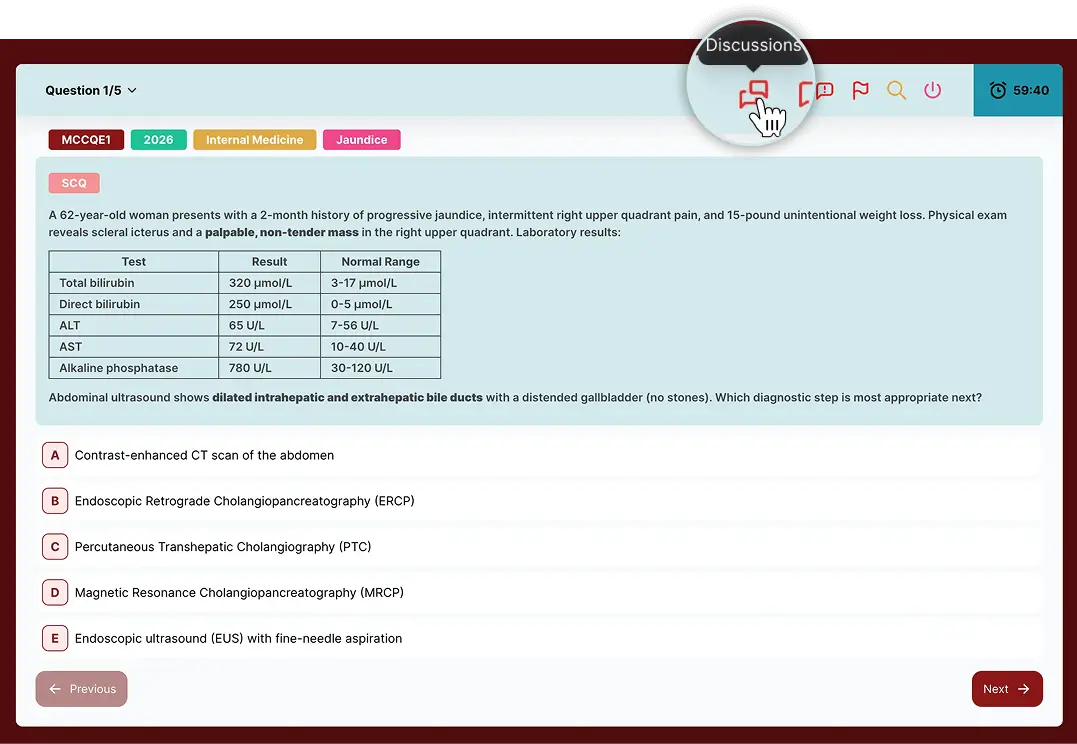
Think of it as having a study group available 24/7. Whether you're studying at 2 AM or during a break between rotations, there's always someone who has wrestled with the same question and can offer insight.
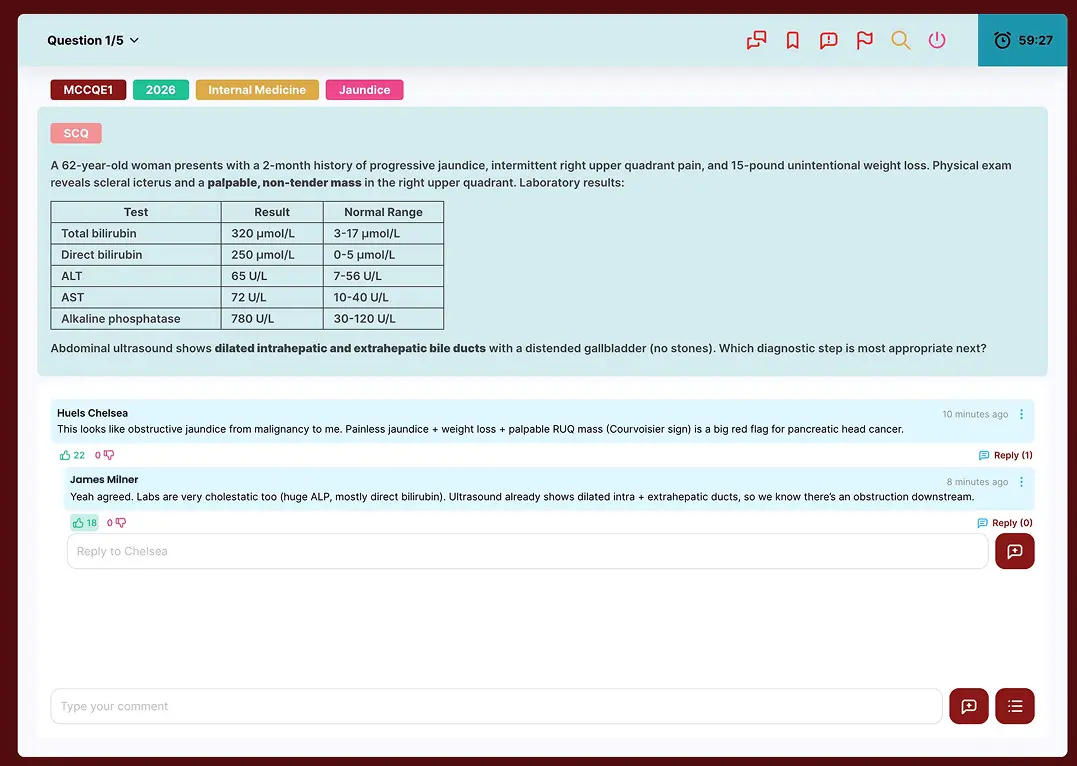
In the example above, you can see a real discussion thread where two medical students are collaborating on a complex clinical case about obstructive jaundice. Notice how Huels Chelsea shares their initial clinical reasoning, identifying key red flags like painless jaundice and weight loss pointing toward pancreatic cancer. Then James Milner builds on that insight, adding specific details about the lab values and ultrasound findings. Each comment includes a timestamp showing when it was posted, upvote/downvote buttons to highlight the most helpful contributions, and a reply counter showing ongoing engagement. You can reply directly to any comment, creating threaded conversations that make it easy to follow complex diagnostic reasoning step-by-step. This is exactly how collaborative learning should work—students teaching students, building knowledge together.
What Makes Our Comment System Different?
Unlike generic forums where you have to search for relevant discussions, our comments are question-specific. You don't waste time scrolling through unrelated threads. Every comment is directly tied to the MCQ you're reviewing, making feedback immediate and contextual.
You also get a notification when someone replies to your comment, so you can stay engaged in the discussion.
How Medical Students Use Comments to Learn Better
1. Share Memory Tricks and Mnemonics
Medical education is full of complex lists and classifications. Students often create clever mnemonics to remember them. In the comments, you'll find:
- Mnemonics for drug side effects, cranial nerves, or diagnostic criteria
- Clinical pearls from students who've seen the condition on rotation
For example, under a question about heart murmurs, a student might share: "I remember systolic murmurs with 'MR. AS' (Mitral Regurgitation, Aortic Stenosis) and diastolic with 'MS. AR' (Mitral Stenosis, Aortic Regurgitation)."
These peer-generated study aids often stick better than textbook explanations because they come from someone who struggled with the same material.
2. Clarify Confusing Explanations
Sometimes the official explanation for an answer is technically correct but hard to understand. That's where peer explanations shine.
Students break down complex reasoning into simpler steps, offer alternative ways to think about the problem, or point out high-yield details that make the answer obvious in retrospect.
If you're confused, you can ask a question in the comments. Often, another student will respond within hours with a clearer explanation or a link to a helpful resource.
3. Catch Errors and Stay Updated
Medicine evolves. Guidelines change. Occasionally, a question or explanation might reference outdated information.
The comment section serves as a peer review system. If a student notices an error or outdated guideline, they can flag it in the comments. Our team reviews these reports and updates the content accordingly.
This crowdsourced quality control ensures you're studying the most current, accurate information—critical for exams like the MCCQE Part 1, which emphasize Canadian clinical practice guidelines.
4. Validate Your Reasoning
Getting a question right feels good, but did you get it right for the right reasons? Or did you just make a lucky guess?
By reading comments from other students, you can validate your thought process. If multiple students explain the answer the same way you reasoned through it, you know you're on the right track. If not, you can adjust your approach before test day.
Building a Supportive Medical Student Community
Preparing for board exams can be stressful and lonely. The comment section isn't just about academics—it's about community.
Students share encouragement, celebrate breakthroughs, and remind each other that everyone struggles with difficult concepts. You'll see comments like:
- "This question destroyed me the first time. Don't worry, it gets easier!"
- "I finally understand this after reading your explanation. Thank you!"
- "Anyone else find Renal Physiology brutal? Let's conquer it together."
This sense of camaraderie can be a lifeline during the grueling months of exam prep. You're not just studying alone—you're part of a global network of future physicians working toward the same goal.
Respectful and Constructive Discussions
To keep the comment section valuable, we ask all students to follow a few simple guidelines:
- Be respectful: Treat others the way you'd want to be treated in a study group.
- Stay on topic: Keep comments relevant to the question at hand.
- Cite sources: If you're correcting information, link to a guideline or textbook.
- No exam content sharing: Discussing practice questions is encouraged; sharing actual exam content violates testing policies.
Our moderation team monitors discussions to ensure the environment stays positive and productive.
Integrate Comments with Other Study Tools
The comment feature works seamlessly with the rest of our QBank platform:
- Exam Simulations: After completing a timed block, review the comments on questions you missed to understand where your reasoning went wrong.
- Custom Exam Builder: Create targeted question sets on your weak areas, then use the comments to deepen your understanding of those topics.
- Chat with Documents: If a comment references a guideline or textbook, use our AI-powered chat feature to instantly find the relevant section in your course materials.
Together, these tools create a comprehensive, interactive learning ecosystem designed to help you master medical knowledge efficiently.
The Science Behind Collaborative Learning
Why does peer discussion improve learning outcomes? Educational research points to several mechanisms:
- Active Retrieval: Explaining a concept to someone else forces you to retrieve and organize information, strengthening memory.
- Metacognition: Reading others' reasoning helps you reflect on your own thought processes and identify gaps.
- Multiple Perspectives: Different students approach problems differently. Exposure to varied reasoning strategies makes you more flexible and adaptive.
- Social Motivation: Knowing that others are working through the same material creates accountability and reduces procrastination.
The National Institutes of Health and Association of American Medical Colleges (AAMC) both emphasize the importance of collaborative learning in medical education. Our comment feature brings these evidence-based principles into your daily study routine.
Start Learning Together Today
Medical school doesn't have to be a solo journey. With our QBank's comment feature, you have instant access to a community of motivated peers who are just as committed to excellence as you are.
Whether you're preparing for the MCCQE Part 1, USMLE Step 1, or any other medical licensing exam, collaborative learning will help you study smarter, retain more, and feel less alone in the process.
Related Posts
![INBDE Mastery Review: Mobile App Features, Adaptive QBank, and Verdict [2026]: feature image](/img/inbde-mastery-review.png) inbde
inbdeINBDE Mastery Review: Mobile App Features, Adaptive QBank, and Verdict [2026]
In-depth review of INBDE Mastery app: 2,000+ adaptive questions, offline clinic studying, clinical mnemonics, pricing tiers, and 300% pass guarantee.
AllQbanks Team •
Aug 18, 2026
 mccqe
mccqeIs MCCQE Equivalent to USMLE?: 2026 Guide
Are the MCCQE and USMLE equivalent exams? Learn where these two medical licensing exams overlap, where they diverge, and whether one can substitute for.
Dr. Leila Haddad •
May 3, 2026